This session marks a milestone: it was the 100th episode of Areopa Webinars. Christian Lenz, an Organizational Designer and Solution Architect at CTM Computer Technik Marketing GmbH in Bremen, Germany, presented on Elastic Leadership — a model developed by Roy Osherove that helps technical team leaders adapt their approach depending on the current state of their team. Moderator Tine Starič facilitated the Q&A.
Christian brings more than 25 years of experience in the Navision and Dynamics ecosystem, having worked as a finance consultant, developer, project manager, and internal facilitator. The talk draws on practical experience rather than formal methodology, offering leaders concrete tools they can apply immediately.
What Is the Elastic Leadership Model?
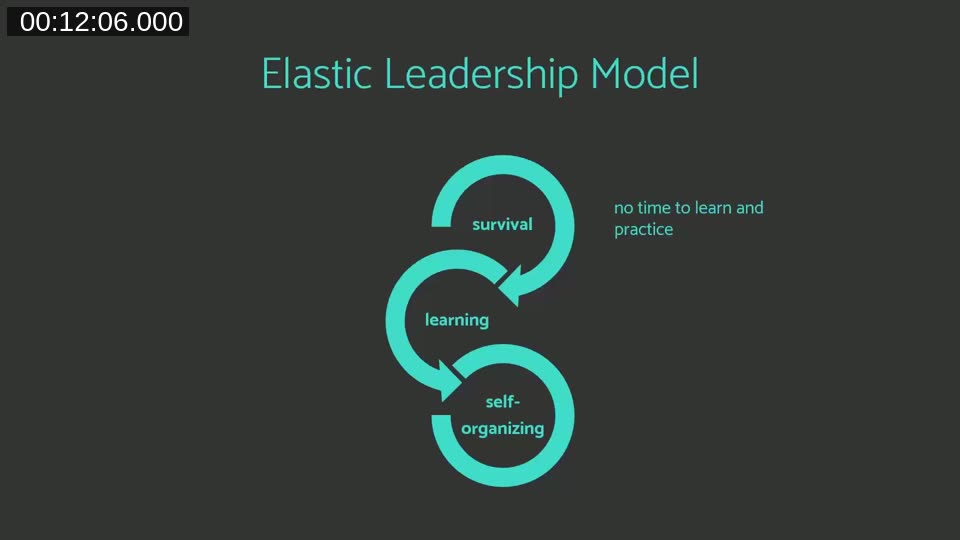
The core insight of Elastic Leadership is that teams move through distinct phases, and a leadership style that works well in one phase can actively harm the team in another. Roy Osherove describes three phases: survival mode, learning mode, and self-organizing mode.
In survival mode, the team has no time to learn or practice — they are constantly fighting fires. In learning mode, slack time has been created and team members can build new skills. In self-organizing mode, the team is capable of identifying and solving problems independently.
📖 Book: Elastic Leadership: Growing self-organizing teams by Roy Osherove (Manning, 2016) — the foundational text behind this model, covering team phases, leadership styles, and the path to self-organization.
Adapting Your Leadership Style
The “elastic” in Elastic Leadership refers to this adaptability. There is no single correct leadership style — the right approach depends on where the team currently stands.
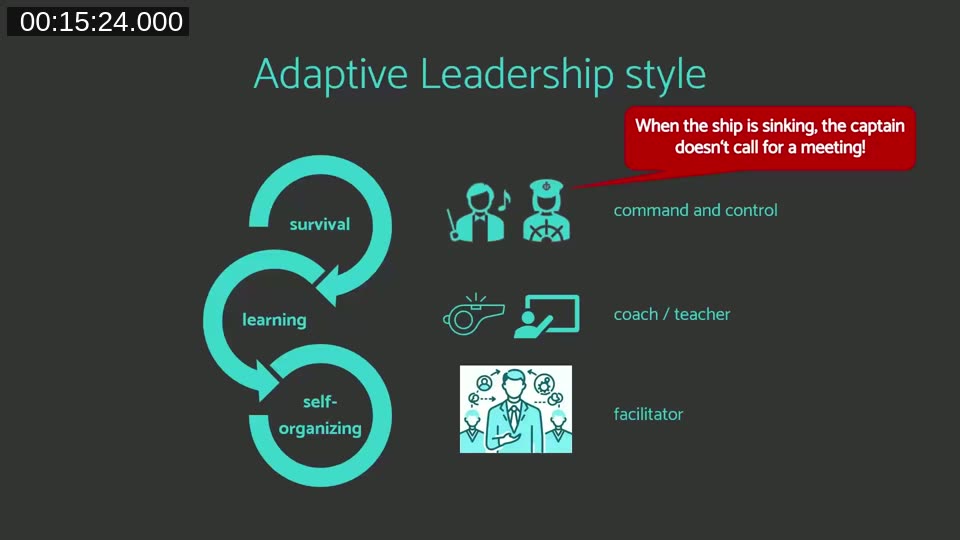
- Survival mode → Command and Control: When the team is overwhelmed, someone needs to make clear calls quickly. As Christian put it, quoting Osherove: “When the ship is sinking, the captain doesn’t call for a meeting.”
- Learning mode → Coach / Teacher: Once breathing room exists, the leader’s role shifts to creating challenges and exercises that help team members develop new skills.
- Self-organizing mode → Facilitator: At this stage, the leader removes themselves from the critical path, monitors whether the team is slipping back toward an earlier phase, and clears organizational obstacles.
Your Role as a Leader
Christian opened by asking the audience to reflect on how they became leaders — common answers included “learning by doing,” “was good at coding and got promoted,” and “was pushed into the cold water.” He framed the underlying purpose of leadership using Osherove’s formulation: grow the team and make yourself unneeded.
This is not about job security — it is about the bus factor. If one person leaving or becoming unavailable can stop the team from functioning, that is a risk the leader should actively address by spreading knowledge and decision-making capability across the team.
Getting Out of Survival Mode
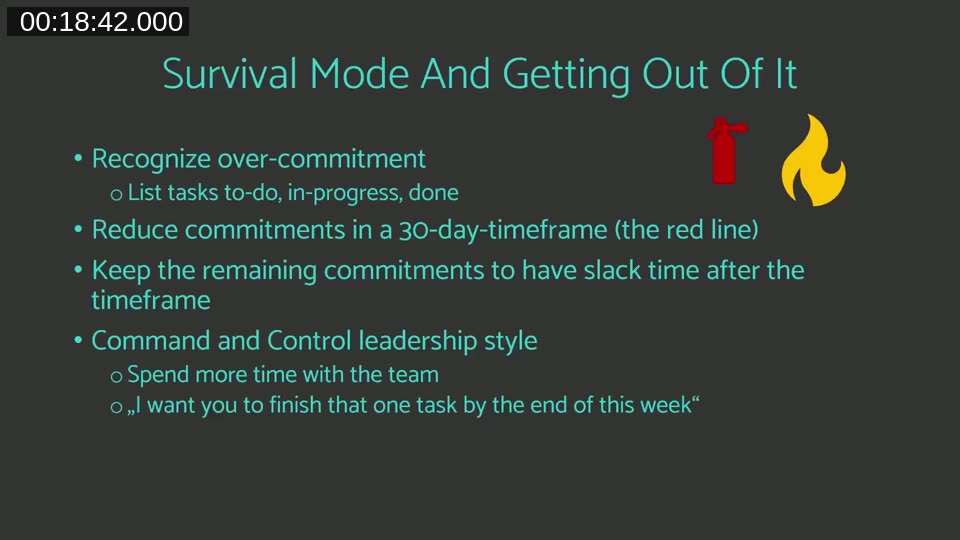
Most teams enter survival mode through overcommitment. Christian outlined a structured approach to escape it:
- Recognize overcommitment. List tasks in three columns: to-do, in-progress, and done. Make the actual state of the team visible.
- Set a 30-day timeframe. Identify which commitments can be completed within that window, then protect that boundary. The goal is to create slack time after the deadline.
- Keep remaining commitments. Do not drop everything — negotiate carefully, inform stakeholders with specifics, and explain the long-term benefit of creating time for learning.
- Spend more time with the team. A good rule of thumb is at least 50% of working time directly alongside team members, even in a remote setup.
Decision Making: Consensus vs. Consent
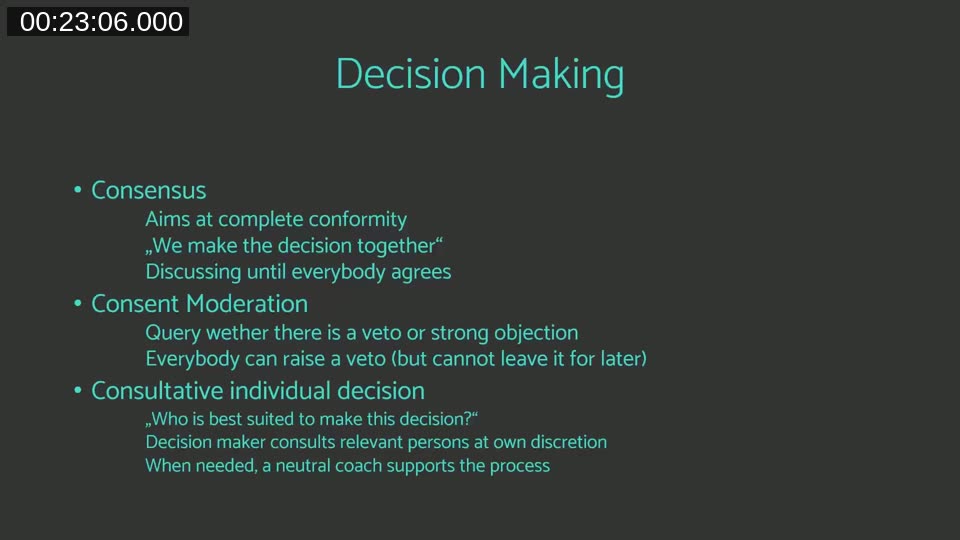
One of the practical tools Christian introduced — not originally part of the Elastic Leadership model — is a shift in how teams make decisions. Most meetings operate on consensus, which requires complete agreement and often results in no decision at all, just a deferred discussion for the next meeting.
An alternative is consent moderation: rather than seeking full agreement, you ask whether anyone has a strong objection or veto to a proposed course of action. If no veto is raised, the proposal moves forward. If one is raised, it must be addressed in the meeting — not deferred to later.
A third approach is the consultative individual decision: identify the person best suited to make a specific call, have them consult the relevant stakeholders, and then make the decision. When the decision-maker is clearly designated, political maneuvering tends to decrease.
📖 Further reading: Consent Decision Making by Sociocracy for All — an accessible explanation of how consent-based decisions differ from consensus, and why the distinction matters for teams that need to move quickly.
The Learning Curve and “Learning Learning”
Christian referenced Jerry Weinberg’s book Becoming a Technical Leader to illustrate how learning actually works. The intuitive image is a straight line upward — steady improvement over time. The reality is a staircase with plateaus and ravines.
Before each leap to a higher skill level, performance temporarily drops. Tasks that previously took one hour now take five. This is not failure — it is the cost of learning something genuinely new. Leaders need to communicate this to stakeholders in advance and build it into planning. If you are asking a team member to tackle something unfamiliar, expect the initial work to take two to ten times longer than the same task done with a familiar approach.
📖 Book: Becoming a Technical Leader: An Organic Problem-Solving Approach by Gerald M. Weinberg — a foundational book on transitioning from individual technical contributor to team leader, with practical models for how learning and growth actually happen.
Making Problems Visible: Commitment Language
A key challenge in survival mode is that problems stay hidden. Team members say what is expected of them rather than raising flags. Christian illustrated this with a personal story: his son would agree to requests he had no intention of fulfilling, because it felt like “no” was not an option.
The remedy is commitment language: framing commitments in the form “I will do [action] by [date].” Vague phrases like “I hope to finish it this week,” “I’ll look at it,” or “as soon as possible” all leave a back door open — they allow the speaker to avoid confrontation while giving the impression of a commitment.
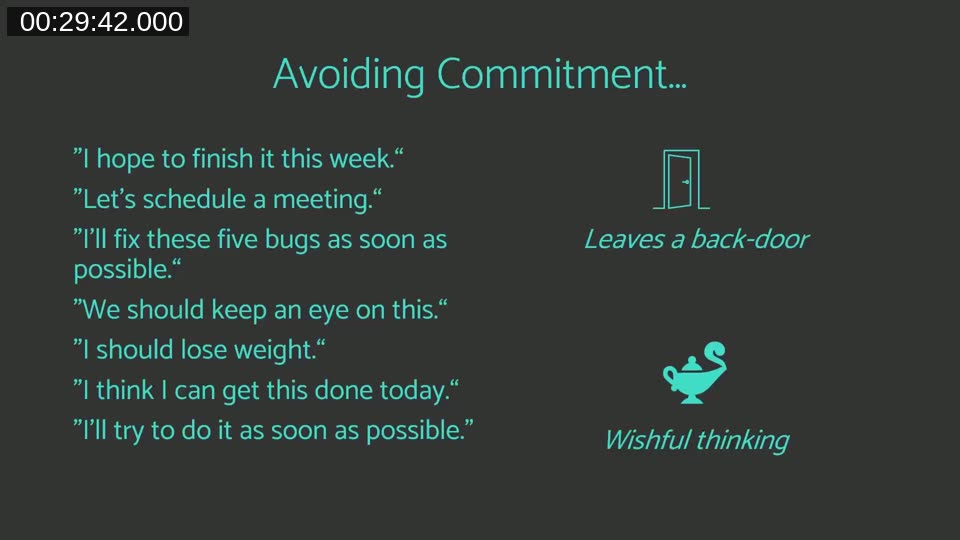
Specific dates create accountability. They also force a more honest conversation: if a developer cannot commit to fixing five bugs by Friday, the more useful commitment might be “I will work on these bugs for at least five hours per day over the next week.” That is something actually within their control.
Christian also noted that sometimes the right answer is to reject a commitment entirely, with a clear reason: “I can’t make this commitment because my manager has assigned me to another project and I won’t have time.” This surfaces the real problem rather than hiding it behind a vague promise.
Observable Effects During the Learning Phase
As a team moves into learning mode, Christian identified several signs to watch for:
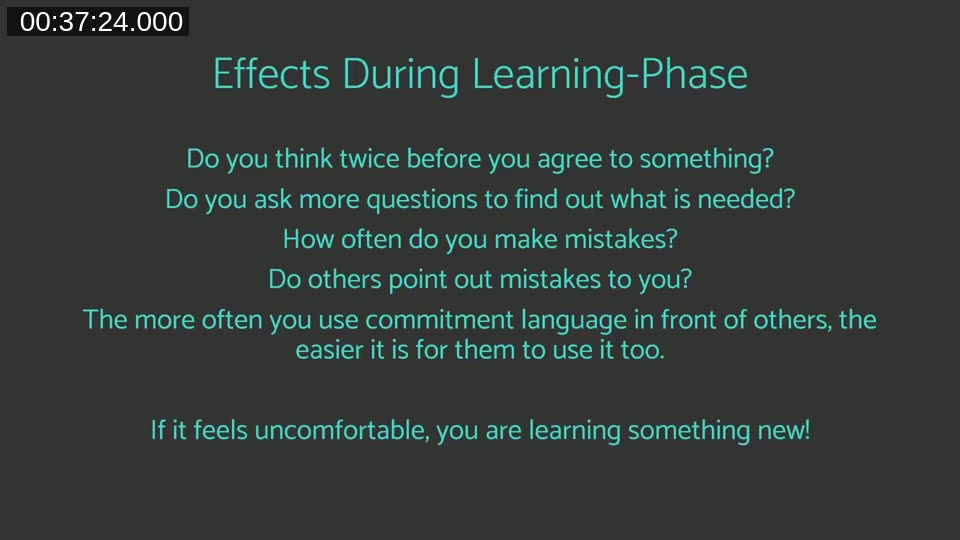
- Team members start asking more questions before agreeing to a scope or estimate.
- People think twice before committing to a deadline.
- Mistakes become more visible because the team is now working on unfamiliar ground — and a healthy team points those mistakes out rather than letting them pass.
- Use of commitment language spreads: once leaders model it consistently, others follow.
The last point deserves emphasis: if a commitment language pattern feels uncomfortable to use in front of others, that discomfort is itself a signal that something new is being learned.
Advancing to Self-Organization: Clearing Meetings
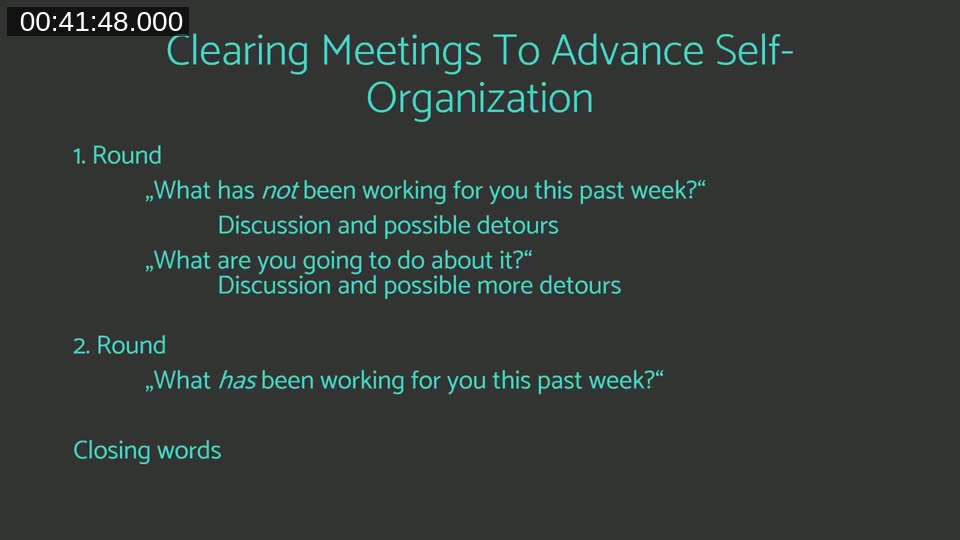
Once a team has grown through the learning phase, the leader’s role shifts again. One tool for supporting self-organization is a clearing meeting — a structured retrospective format with two rounds:
- Round 1: What has not been working for you this past week? After each response, follow up: what are you going to do about it?
- Round 2: What has been working for you this past week?
The format creates a space where team members surface issues and commit to actions in the same conversation. Christian noted that in practice, many participants arrived having already addressed the problems they raised — which is a strong signal that self-organization is taking hold.
Creating Safe Spaces for Change
Transitioning through phases rarely happens in the middle of regular project work. Christian described the approach his team used when developers needed to move from C/AL to AL: they ran learning sprints — three to four days where five or six developers worked in the same room, with one or two more experienced colleagues on hand. Participants chose their own topics voluntarily. Daily business was suspended for the duration.
The outcome was not that everyone became AL experts overnight. It was that the fear of the unknown dropped significantly. One colleague who knew how to solve a problem in C/AL but was stuck in AL was advised to prototype it in C/AL first, then port it — a practical workaround that let the learning happen without blocking progress.
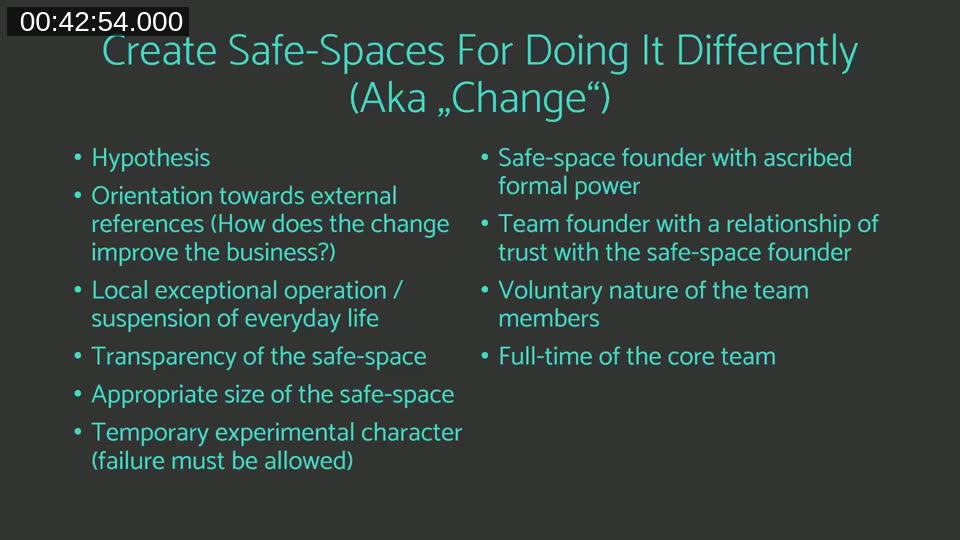
For safe spaces to work, Christian outlined several conditions: they need a founder with formal authority and a relationship of trust, they need to be time-limited and transparent, participation should be voluntary, and the core team should be fully committed — not split across other projects simultaneously.
Q&A Highlights
Tine Starič raised the question of how to apply this in a large team of 30 developers. Christian’s answer was to start by mapping the skills and commitments of the whole group before extracting a subgroup: taking the “heroes” out of a larger team can leave the rest unable to meet their existing commitments — a worse outcome than staying in survival mode longer.
On the topic of stakeholders bypassing agreements and pushing new commitments onto a team mid-transition: the primary response is to make those commitments visible. Documenting and surfacing what is being asked of the team creates the conditions for an honest negotiation about what is actually possible.
Christian closed with a quote from Ed Catmull’s Creativity Inc.: “Part of our job is to protect the new from people who don’t understand that in order for greatness to emerge, there must be phases of not-so-greatness.” The learning phase, with its temporary slowdowns and increased mistakes, is not something to engineer around — it is the path through.
This post was drafted with AI assistance based on the webinar transcript and video content.