
Jeremy Vyska gave his first virtual talk in 2020 and stood on a physical stage for the first time in 2022. In April 2026 he accepted a request to fill a 90-minute Saturday slot at Days of Knowledge Nordic in Odense, with one day to prepare. In this webinar for the 130th Areopa session he looks at the six years that made that yes possible. Luc van Vugt moderates.
Jeremy is a Business Central MVP and Lead Architect at BrightCom with more than 25 years in NAV and Business Central. The session covers how he started, the practice and tools he relies on, how he prepares a talk now, and how AI agents fit into that preparation without replacing his own work.
The Deck Is the Receipt, You Are the Art
The title refers to Brandon Sanderson’s keynote “We Are the Art”. Jeremy summarizes its point as: the process of creating art makes art of you. The finished product is the result, and the person who grew while making it is the real outcome.
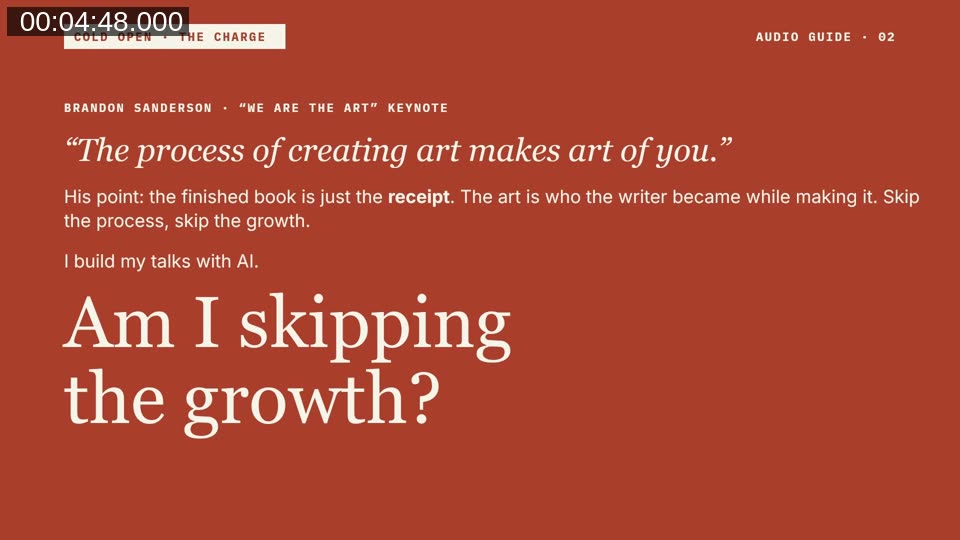
Jeremy applies this to Business Central work. Customers care whether their problem is solved, not how the developer grew, so practitioners have to champion their own growth. He builds most of his talks with AI, and he uses the session to test whether that skips the growth.
He warns against being a “meat proxy”: someone who passes AI output to the next person without adding anything. His rule is that agent sessions are discarded, but the person who used them is not. The slides are the receipt that proves the work happened. The speaker is what the work made.
📖 Source: Brandon Sanderson’s keynote — the talk behind the title, linked in the webinar description.
Every talk he builds starts with one question: what should a person leave thinking, or leave with? He often opens by saying that if the audience already knows 90% of the content, he hopes the remaining 10% makes the difference.
Act 1: Fire, Forge, and the Yes
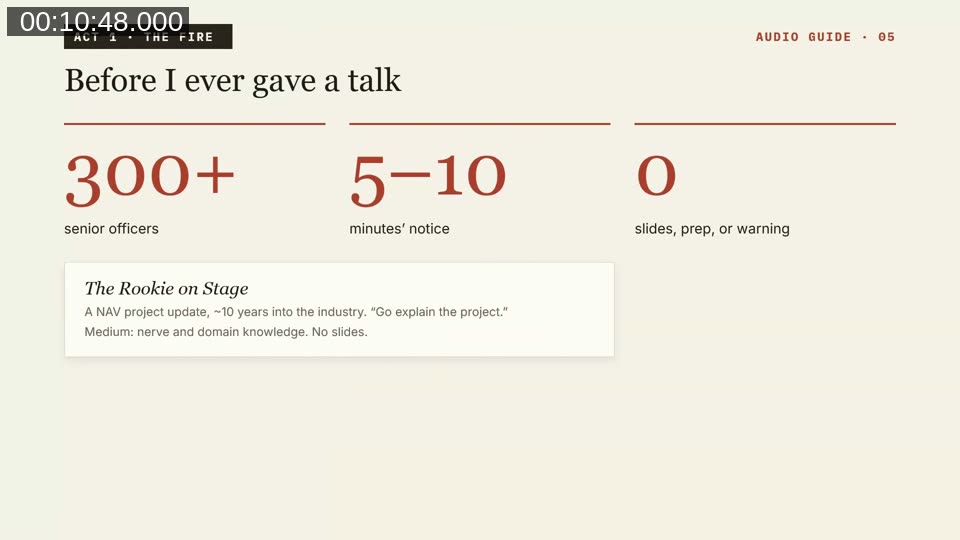
Before his first talk, Jeremy had already faced the worst case. Roughly ten years into working with NAV, he was on a project for a military branch. The project manager told him he had a few minutes to explain the project to a room of senior officers, with no slides and no preparation. The lesson he kept is that the audience chose to be there and wants something of value.
Three experiences then shaped how he speaks:
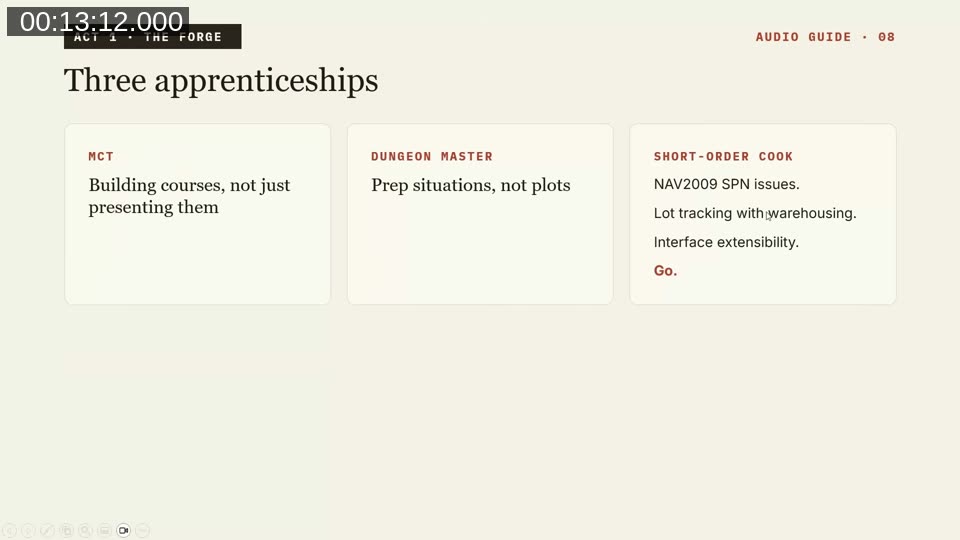
- Microsoft Certified Trainer program — building courses and structuring stories, not only presenting them.
- Dungeon Master for tabletop games — preparing situations, not plots, and improvising around the dice.
- A three-month advisory service — weekly calls on any topic, from NAV 2009 web services to warehousing and interfaces, which he compares to being a short-order cook.
These led to Days of Knowledge Nordic in Odense. On Friday morning a speaker’s travel fell through and a 90-minute slot opened. Jeremy gave his scheduled talk that morning, started preparing during the keynote, and delivered the new talk on Saturday. He credits the six months of practice before it and the six years behind that. If you lack similar chances, he suggests creating them, for example by turning an internal training into a short practice talk.
Act 2: Reps and the Kit
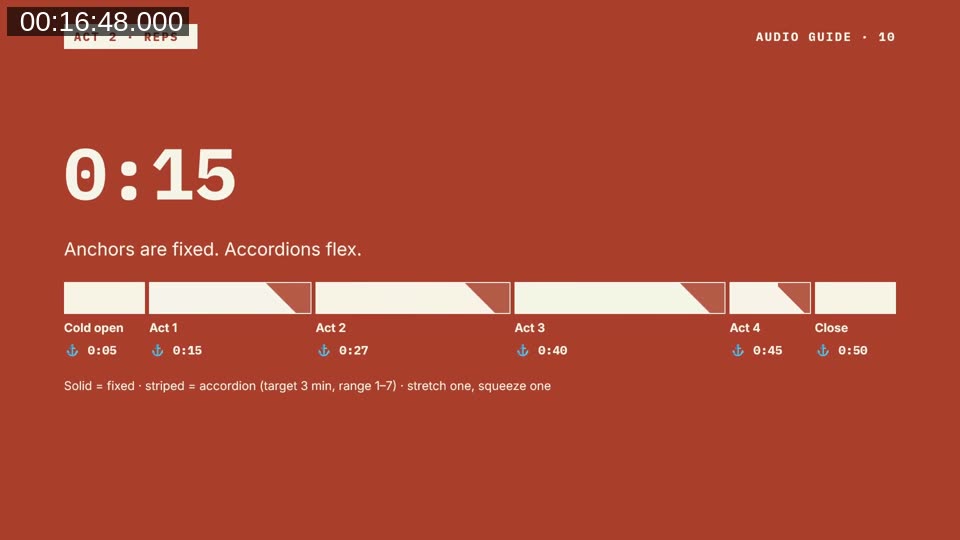
Jeremy structures every talk in anchors and accordions. Anchors are fixed points in time where he knows where he should be. Accordions are topics between anchors that he can stretch or squeeze, so the talk keeps its timing without losing the plot.
Three other habits support this:
- Present from the slide, not off it. Slides are anchors for the audience. Reading them aloud turns the talk into recitation.
- Read the room. He asks early whether the audience is mostly consultants, developers, or executives, then brings up the pain points that match. In a webinar he cannot see the room, so this is harder.
- Treat the deck as prompts. It holds the main points, not a script.
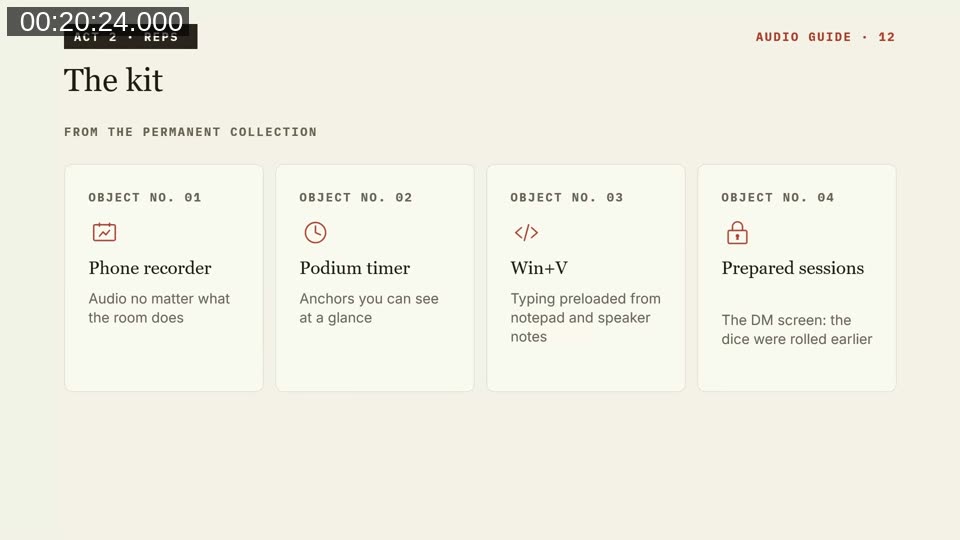
He also keeps a small set of tools, which his slide calls “the kit”:
- Phone recorder — he records every talk, whether or not the organizer does.
- Podium timer — so he can see his anchors at a glance.
- Windows+V multi-clipboard — text such as prompts is preloaded, so he never types in front of the audience.
- Prepared sessions — because AI output is non-deterministic and slow, he opens agent sessions he ran earlier and walks through them instead of waiting on a progress bar.
He prepares situations, not scripts. Like index cards on a desk, each point is a separate piece he can reorder, and optional material is triggered by the audience. His example is asking how many people dislike updating DevOps work items, then moving to a skill that does it for them.
Act 3: How the Talk Was Built
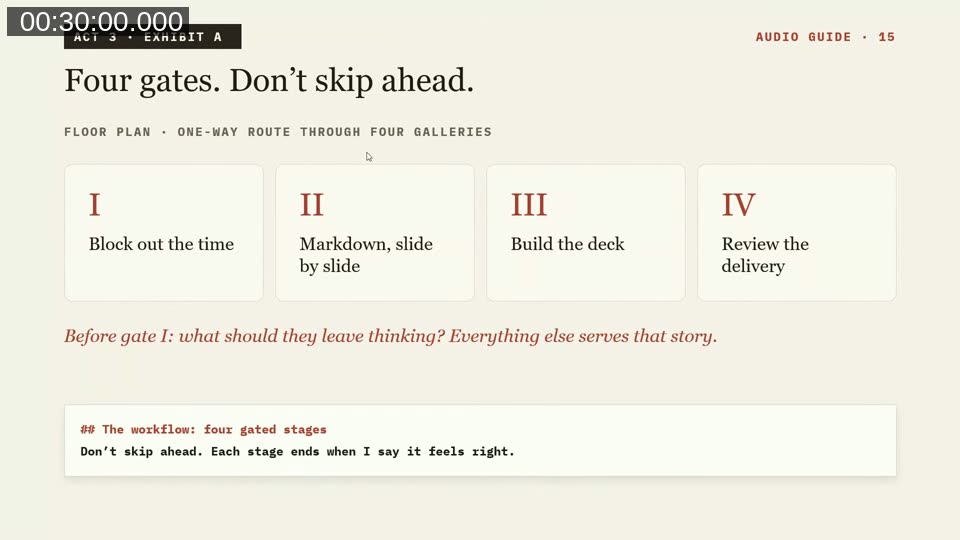
Jeremy shows the Claude chat he used to build this webinar. He started it on 23 September, five days before the session. It took 24 of his own messages, and he deliberately slept on it before finishing. The agent supplied structure and questions. The stories, such as the military talk, came from him. The deck now lives in his instruction file as a four-stage workflow:
- Block out the time. Decide how long the talk is and brainstorm everything that could go in. The guiding question is what the audience should leave thinking.
- Write the slides in Markdown, slide by slide. Markdown is cheap to change, and each stage must be right before moving on because the cost of change rises later.
- Build the deck.
- Review the delivery.
As a second example he shows the Odense emergency talk, “Agentic Dev for BC Devs: Mental Models, Tools, and Making It Stick”. He took an existing one-hour class and extended it by half an hour. The timing table was done by lunchtime on Friday, and the rest of the afternoon went into evolving the content. He asked attendees to be kind because he wrote it the day before, and it became one of the highest-rated sessions of the event.
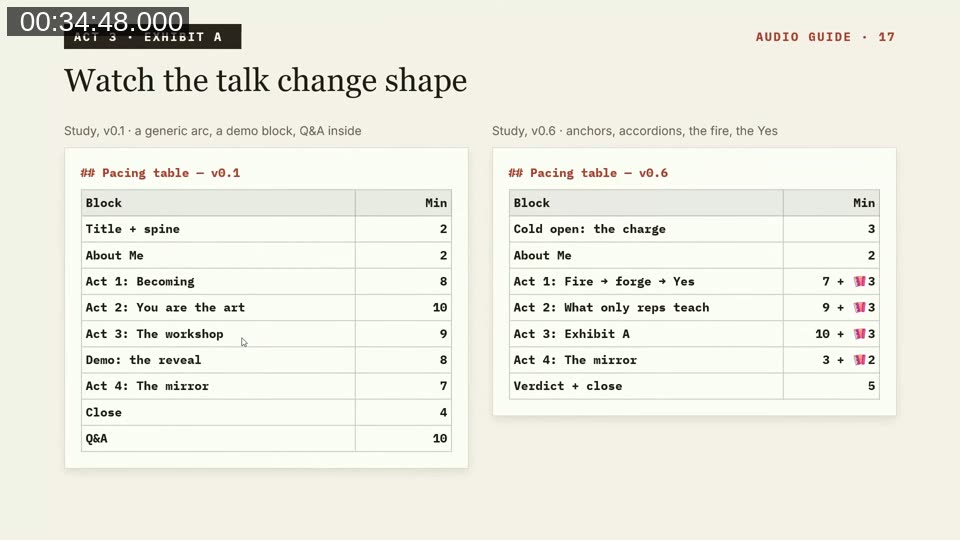
For this webinar the pacing table went through six drafts and the slide Markdown through six drafts, producing about 27 slides. Jeremy says the agent learns how he delivers over time. He prefers terse prompts as speaker notes rather than lines to read. The accordion stretches, the storytelling and the audience engagement remain practice and skill.
Jeremy no longer builds PowerPoint decks by hand and says there is no need for him to become a PowerPoint expert. As a small example, Claude chose a font that was not installed on his machine, and text glitched ten minutes before the session. He asked Copilot to find and replace the font and it fixed all 237 occurrences in about 30 seconds. His point is that he needs the shape of what comes out, not the machinery behind it.
Act 4: The Mirror and the Talk Eval Kit
Jeremy records every talk on his phone and runs the audio through a talk eval kit. He credits Steve Endow and Tobias Fenster with contributions to the kit. The kit creates a local transcript with Whisper, calculates metrics such as words per minute, filler words, pauses, and audience questions, and then reports what he conveyed against what he intended.
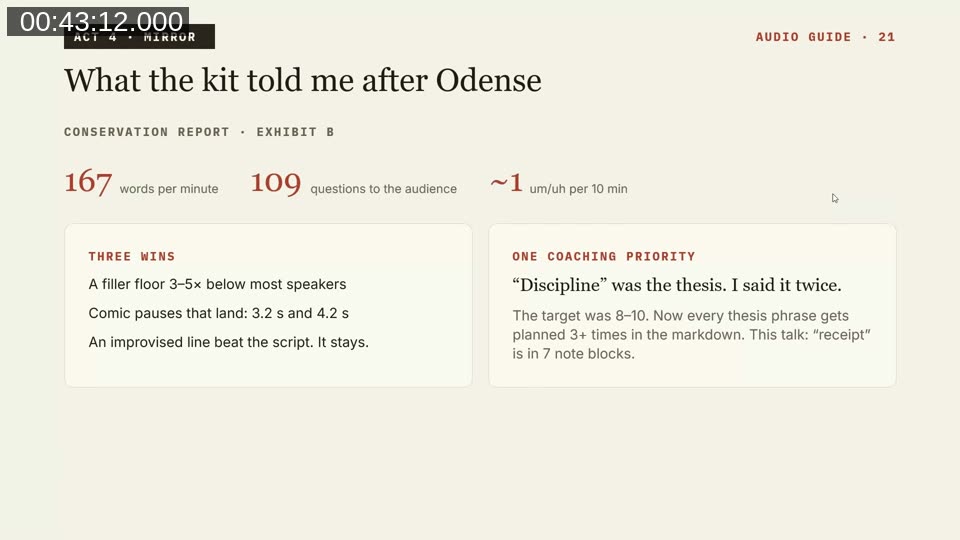
The report on the Odense talk showed 167 words per minute, 109 questions to the audience, and about one filler word per 10 minutes. It also flagged one coaching priority: “discipline” was the thesis of that talk and he said it only twice. His advice on filler words is to pause instead, because everyone is waiting and you are allowed to breathe. He expects the report on this webinar to criticize him for not saying “receipt” often enough, which he calls Claude language, not his own.
📖 Repository: copilot-junk-drawer — GitHub repository by Jeremy Vyska that contains the talk-eval-kit folder, a local toolkit that transcribes talk recordings and measures delivery metrics.
Jeremy plans to publish the review of this webinar as a blog post on Nubimancy and asked for the link to be added to the video description once it exists.
The Verdict: Six People in a Room for Thousands
Jeremy also addresses the fear that nobody will attend. At Directions EMEA he gave a talk with Stefan Maron on open source in Business Central. They were scheduled in a keynote room for three to four thousand people, and about six attended.
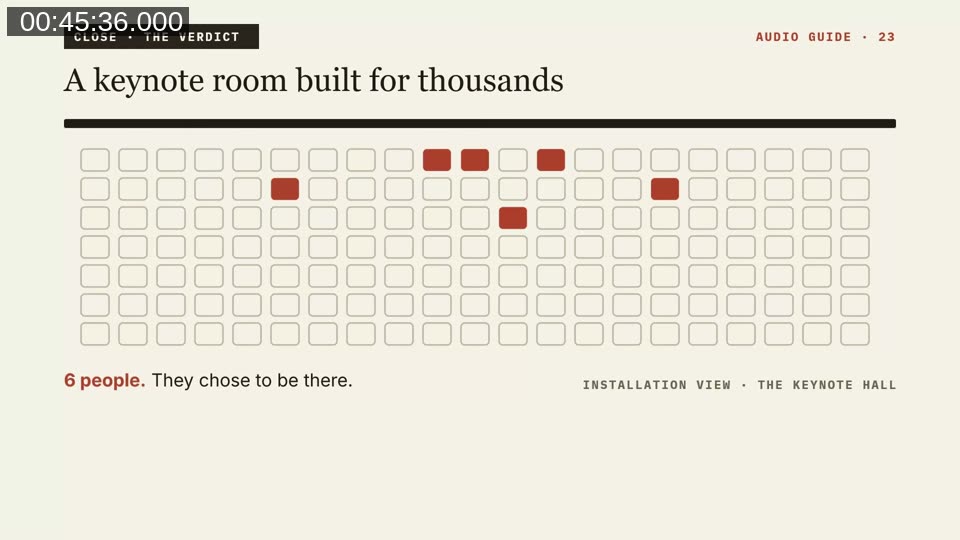
One of those six was Arthur van de Vondervoort. He went on to create LinterCop with Stefan Maron after the talk, and the project continues as a community effort. For Jeremy, this shows that impact matters more than volume and that it may be invisible. A talk can make art of someone else.
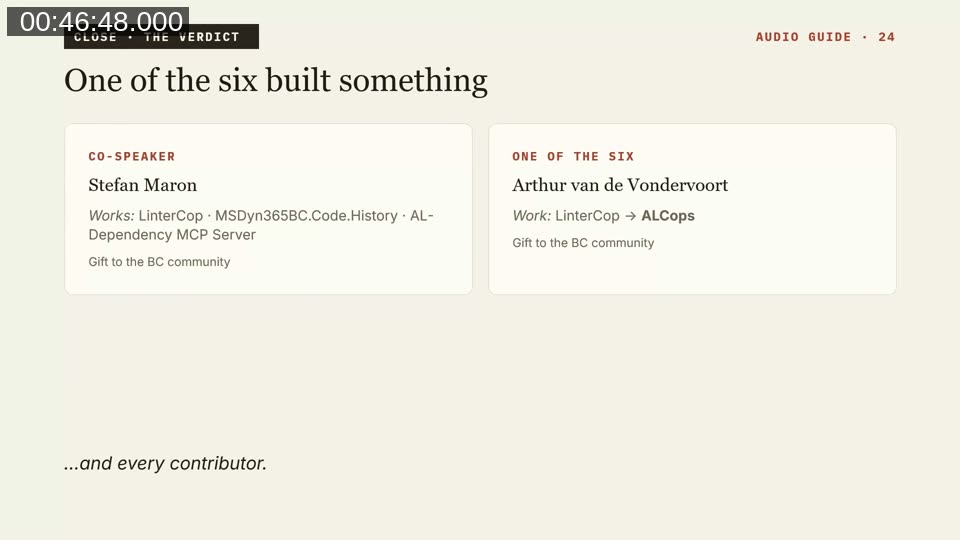
📖 Project: BusinessCentral.LinterCop — open-source code analyzer for AL. The repository page notes that it is now deprecated in favor of ALCops.
When Monday Comes
Jeremy ends talks with a beat for the time after the session, when the audience has to go back to work and often convince someone else. The best parting gifts either make the action cheaper to implement or make the idea easy to champion. His published eval kit is the first kind. A clear answer to “what was that talk about?” is the second.
His closing advice by audience:
- Never presented: assume the audience chose to be there, and do not be scared of empty chairs.
- Regular speaker: record every talk and review one. Aim for the “now I know” moment.
- Agentic tinkerer: after using the tool, ask whether you are better or only done. Do not be a meat proxy.
Q&A
- Co-speaking or solo? Jeremy recommends co-speaking when starting out: a second speaker can hold the room when a demo fails or a slide glitches. Experienced speakers can enjoy solo talks, but co-speakers can also share a bigger idea, split the topics, and present opposing views.
- How do you rehearse? Because the talk is blocked into acts, he rehearses 20 to 30 minutes at a time instead of the whole session. If a demo risks running long, he records it and plays it back at 2x speed. The day before, he does one full run-through, mostly under his breath.
- Has shorter prep time changed things? In the first years he spent about a week on a talk and now about four hours. He does not want this to lower the bar, since good talks still need time. He also treats internal training as practice talks, and trusts more that the audience came to listen.
- Agent as a place to keep your experience. Luc suggested Jeremy has put his experience into the agent. Jeremy plans to spend an hour or two telling his agent stories, such as deleting the G/L Entry table on purpose, to build a repository of stories to draw on.
This post was drafted with AI assistance based on the webinar transcript and video content.