Global Mediator is a development house based in Kyiv, Ukraine. More than eighty percent of its staff are software engineers, and roughly two-thirds of its business sits on the Microsoft Dynamics platform. The company does not sell Dynamics licenses — its customers are independent software vendors and larger end-users who already know what good NAV code looks like.
That last point matters. Because Global Mediator’s clients can tell the difference between solid and mediocre work, the company has no room to quietly slip a junior into a live project and hope for the best. At the same time, the company was growing at more than forty percent per year, a pace the Ukrainian Dynamics talent market simply could not supply.
Three Constraints, One Decision
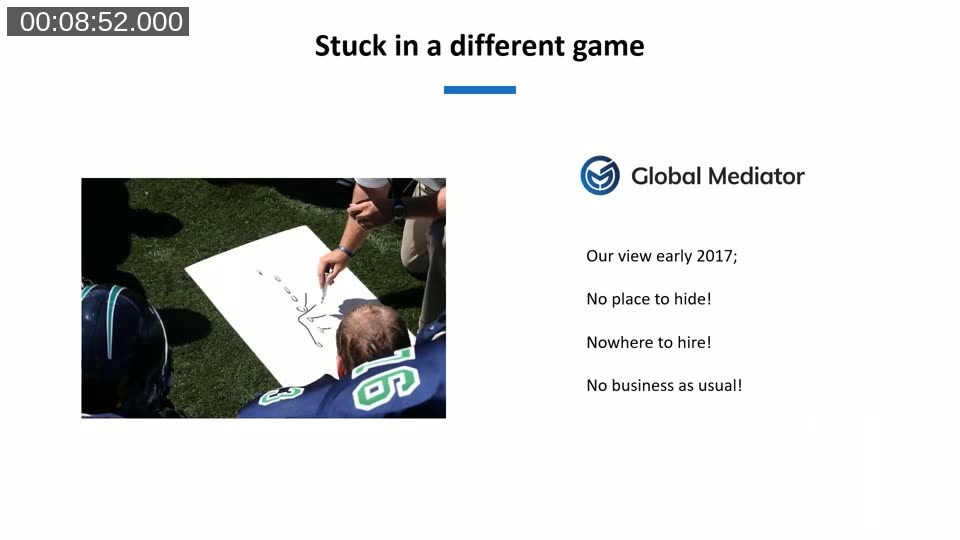
In early 2017, Global Mediator’s COO Nicolai Krarup described the situation in three short phrases: no place to hide, nowhere to hire, no business as usual. The company already held the largest NAV development centre in Ukraine, which meant there were few competitors to poach from. And with Microsoft actively tearing apart the NAV monolith and rebuilding it as Business Central, simply doing more of the same was not an option either.
The decision was to stop waiting for the market and start growing talent internally — but under conditions strict enough that the result would actually be production-ready.
We cannot hide from our customers that we have somebody in learning mode. Our customers are simply too good for that.
— Nicolai Krarup, COO, Global Mediator
Who They Look For
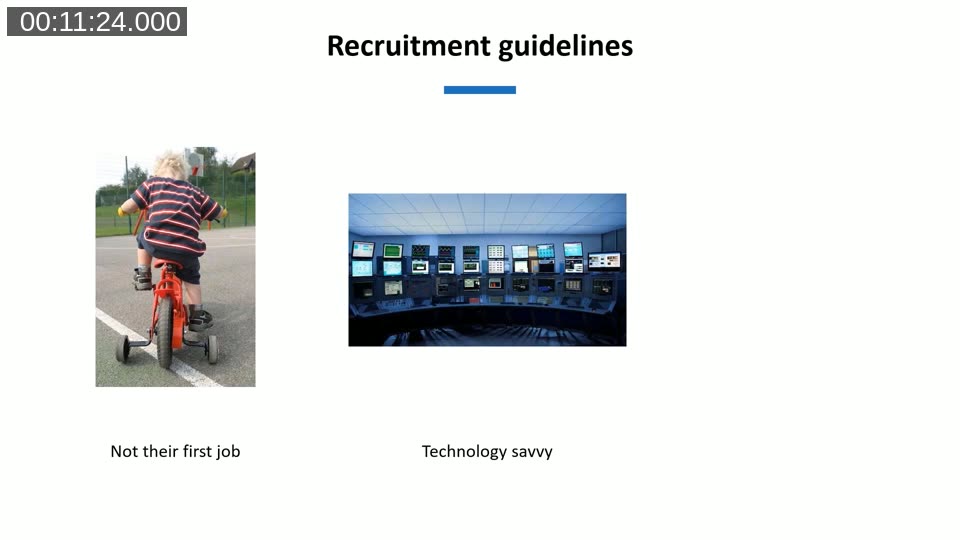
Global Mediator does not recruit straight from university. The company looks for candidates with three to four years of experience on other platforms — enough time to have learned how to function in a professional environment before being handed NAV. A technical background is preferred, but the company has also hired people with strong finance backgrounds who decided to learn to code; their understanding of business processes turns out to be a genuine asset.
The other non-negotiable is the ability to self-direct. Because the company’s training model relies on the candidate driving their own progress, people who need every step spelled out will not get through it.
We have found that new people adjust to newer technologies a little bit faster than people who already have old habits. They more easily adapt to the new norm — that not every problem is something you can solve by taking your NAV tool-hammer out of the box.
— Nicolai Krarup
The Teaching Model
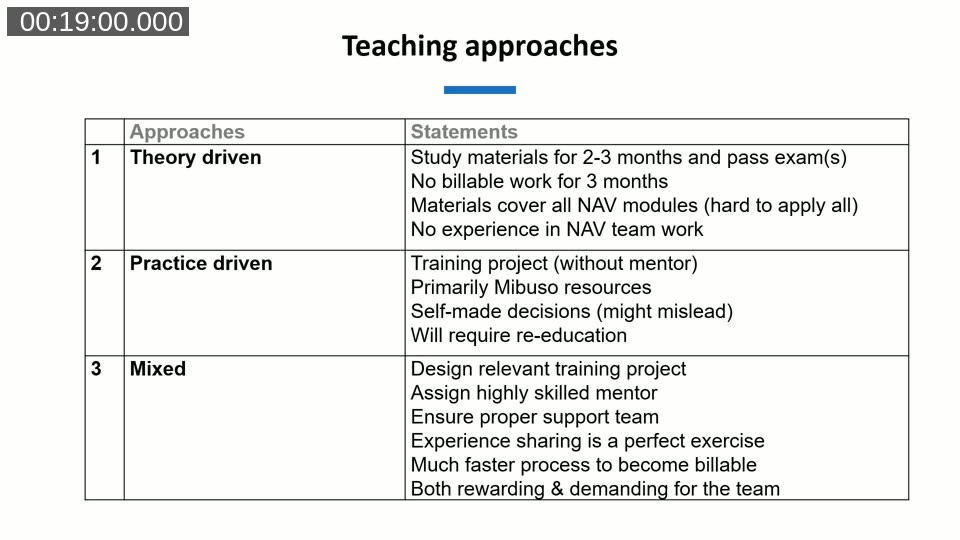
Delivery Director Evgeny Buriak drew on three educational philosophies when designing the programme: Montessori (freedom and observation), Waldorf (real-life orientation, preparing students for genuine challenges), and the Harkness method (round-table discussion with individual guidance). All three share a common thread — practical, student-centred learning with a mentor in the room rather than a lecturer at a podium.
Buriak mapped this against three broad approaches he sees in the industry. A purely theory-driven path means two to three months of reading manuals with no billable output and no team experience. A purely practice-driven path means the trainee makes their own decisions, sometimes based on wrong assumptions, with no one to correct them. The mixed approach is what Global Mediator uses: a real training project with clear goals, supported by documentation, mentored by a senior, and surrounded by a team willing to answer questions.
The Five-Stage Process
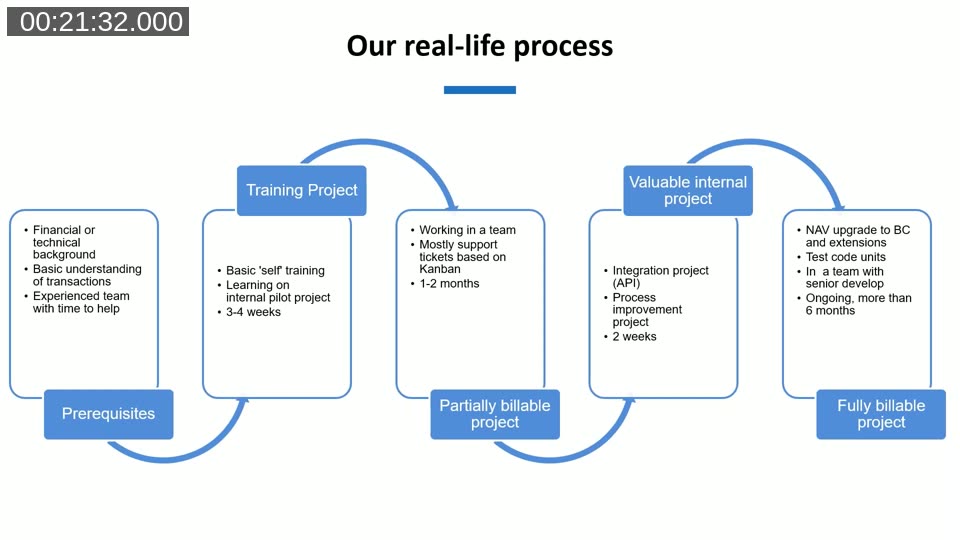
The onboarding path has five stages.
- Prerequisites. The candidate brings a financial or technical background, a basic grasp of transaction logic, and joins a team that has time to help.
- Training project (3–4 weeks). A self-contained internal project with well-defined requirements and a clear end goal. The trainee works largely independently but has a senior available roughly one to two hours a week to unblock difficult questions.
- Partially billable project (1–2 months). The trainee joins a live client team working on Kanban. Tickets are pre-selected and ordered by difficulty, starting simple and becoming more demanding. This stage generates real revenue.
- Valuable internal project (approx. 2 weeks). An integration project that requires skills the trainee already has from their previous career — JSON, REST APIs, regular expressions — combined with NAV. The overlap reduces the learning burden and builds confidence.
- Fully billable project. Business Central extensions, working alongside a senior team member. This stage was still ongoing for the cohort described in the webinar.
After one month of the training project, the student is already partially billable. That is good for the company economy.
— Evgeny Buriak, Delivery Director, Global Mediator
Results in Numbers
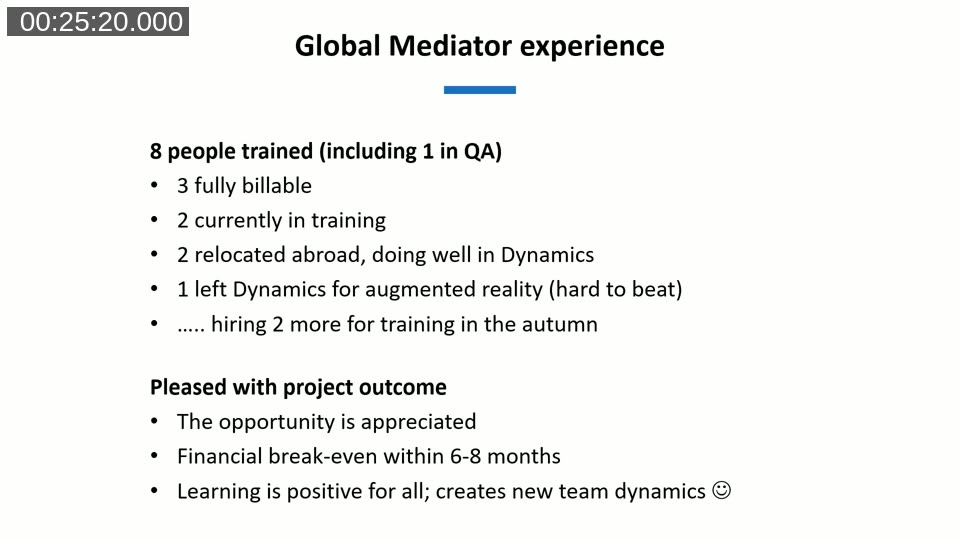
By July 2019, Global Mediator had put eight people through the programme, including one in QA. Three were fully billable. Two were still in training. Two had relocated abroad but remained in Dynamics. One left for augmented reality — which Buriak acknowledged was hard to compete with. The company was planning to add two more trainees that autumn.
The financial break-even point came at six to eight months from the start of training. Buriak described the overall outcome as a positive for the whole team, not just the trainee: knowledge sharing creates new dynamics inside a group, and the questions that new people ask tend to push senior developers to articulate things they had long taken for granted.
Yuriy Popov’s Experience
Yuriy Popov is the developer whose journey the webinar centres on. He arrived at Global Mediator in early 2018 with seven years of experience in 1C — a widely used ERP system across CIS countries with a similar financial scope to Dynamics NAV. That background turned out to be almost directly transferable: both systems model the same business processes, both support event-driven extension patterns, and both operate on similar transaction logic.
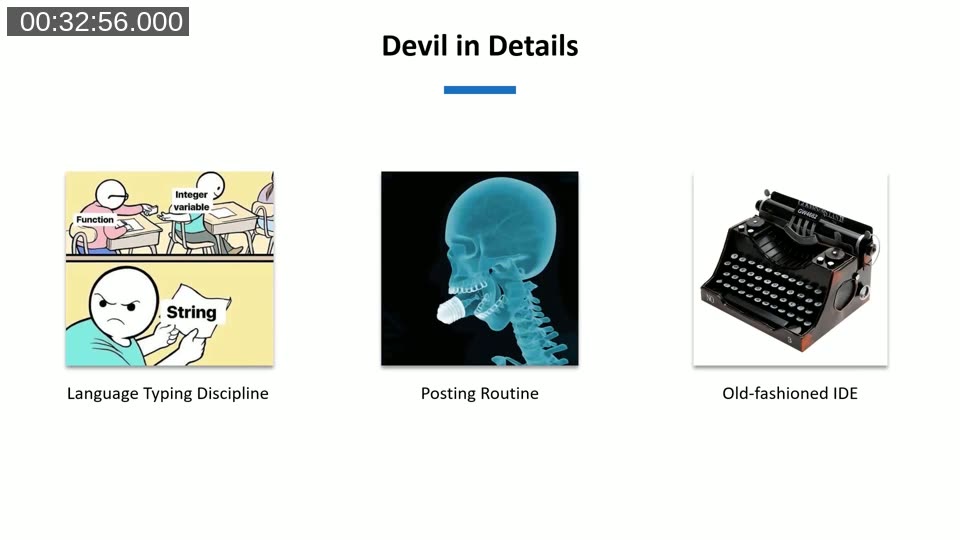
The genuine differences were narrower than he expected. Moving from a dynamically typed language to AL’s static typing was an adjustment. NAV’s posting routine — where posted documents cannot simply be undone — was a conceptual shift from what 1C allows. And the classic NAV development environment (C/SIDE) struck him as dated compared to what he was used to. All three, he said, turned into learning experiences rather than blockers.
When Luc van Vugt asked what the hardest part of the change was, Popov answered without hesitation: English. The technical content was manageable. Communicating with international clients was the steeper hill.
Live Demo: Converting NAV C/AL to Business Central AL
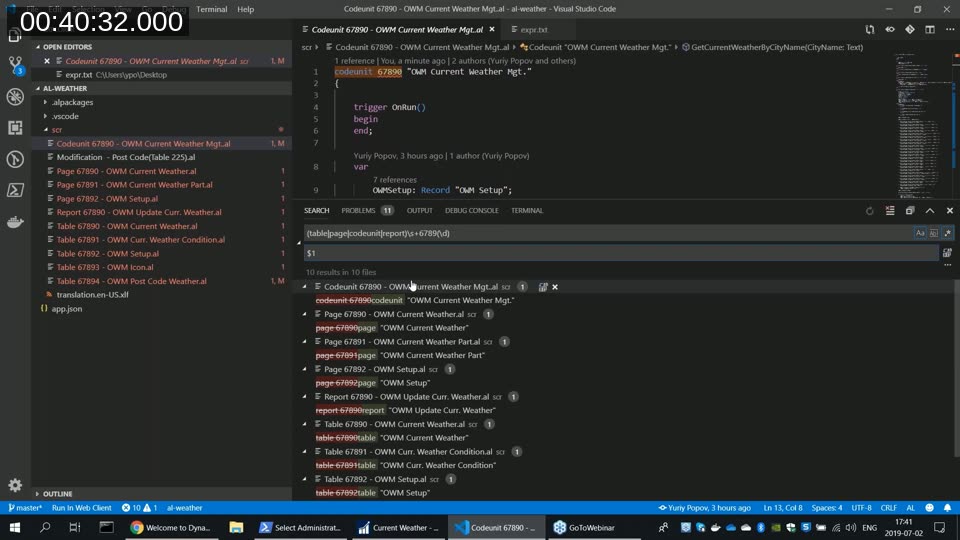
Popov closed his session with a live demonstration that illustrated how his prior experience shaped his work at Global Mediator. He had written a NAV 2018 modification that fetches weather data from the OpenWeatherMap API. The task was to move that code into a Business Central extension running inside a Docker container.
The conversion required replacing .NET variable calls with standard AL HTTP client calls, adjusting the object ID range to match the extension’s app.json configuration, and setting the ApplicationArea property on all pages and page fields. Popov handled the bulk of the object ID renaming and ApplicationArea assignments using regular expressions in VS Code’s search-and-replace panel — a technique he brought from his 1C background. The demo ended with a successful package build and publish to the BC Docker container, even if the live API call ran into network restrictions on the day.
This post was prepared with the assistance of AI from the Areopa Academy webinar recording. Speaker quotes have been lightly edited for readability.